ISO 14819-1:2021 Intelligent transport systems — Traffic and travel information messages via traffic message coding —Part 1: Coding protocol for Radio Data System-Traffic Message Channel (RDS-TMC) using ALERT-C
标准简介
Intelligent transport systems — Traffic and travel information messages via traffic message coding —Part 1: Coding protocol for Radio Data System-Traffic Message Channel (RDS-TMC) using ALERT-C是ISO发布的ISO标准,适用于全球。标准截图
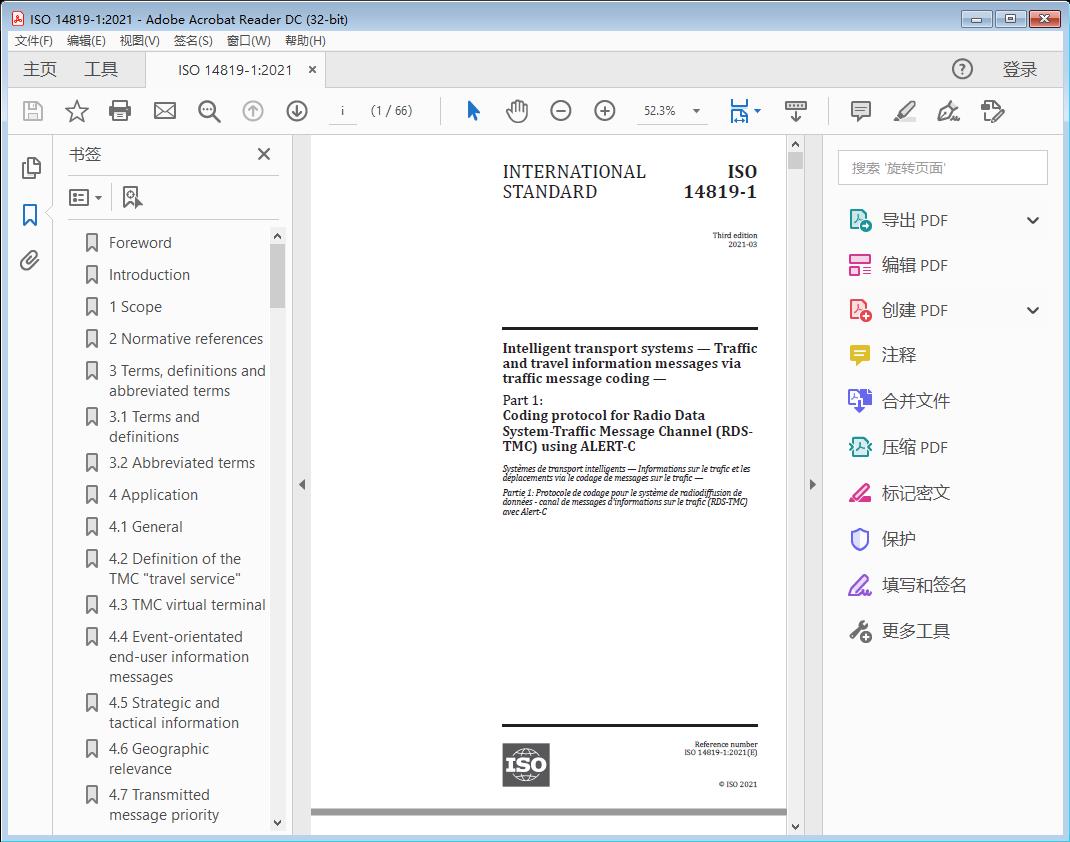
标准文档说明
标准文档类型为Intelligent transport systems — Traffic and travel information messages via traffic message coding —Part 1: Coding protocol for Radio Data System-Traffic Message Channel (RDS-TMC) using ALERT-C高清PDF版本(文字版),标准文档内可进行搜索,可以复制原文,可粘贴。标准部分原文
Intelligent transport systems — Traffic and travel information messages via traffic message coding —
Part 1: Coding protocol for Radio Data System-Traffic Message Channel (RDS-TMC) using ALERT-C
1 Scope
The ALERT-C protocol is designed to provide mostly event-oriented road end-user information messages. This document specifies the messages which are presented to the user in accordance with a set of general requirements. It defines the message structure and content and its presentation to the end-user.
The message management component of this document describes the message management functions of RDS-TMC. The ALERT-C protocol distinguishes between user messages and system messages. User messages are those potentially made known to the end-user, as defined in Clause 5. System messages are of use only to the RDS-TMC terminal, for message management purposes.
RDS-TMC information comprises both ‘system information’ and ‘user messages’. System information relates to the TMC service and details the parameters that the terminal needs to be able to find, identify and decode the TMC information. System information is transmitted in type 3A groups and in type 8A groups.
User messages contain the details of the traffic events; these may use one or more type 8A groups. Most messages may be transmitted using a single type 8A group, however messages with more detail (e.g. diversion advice) may use up to a total of five, type 8A groups.
The transmission component of this document conveys the messages over-air. The ALERT-C protocol, used by RDS-TMC, has the fundamental approach of aiming to code most messages entirely within a single RDS group.
The ALERT-C Event List, which contains all event descriptions, is described in ISO 14819-2.
2 Normative references
The following documents are referred to in the text in such a way that some or all of their content constitutes requirements of this document. For dated references, only the edition cited applies. For undated references, the latest edition of the referenced document (including any amendments) applies.
ISO 4217, Codes for the representation of currencies
IEC 62106 (all parts), Radio data system (RDS) — VHF/FM sound broadcasting in the frequency range from 64,0 MHz to 108,0 MHz
3 Terms, definitions and abbreviated terms
3.1 Terms and definitions
For the purposes of this document, the following terms and definitions apply.
ISO and IEC maintain terminological databases for use in standardization at the following addresses:
— ISO Online browsing platform: available at https:// www .iso .org/ obp
— IEC Electropedia: available at http:// www .electropedia .org/ 3.1.1
access profile
ACP
unique description of a particular RDS-TMC service and subscription period
3.1.2
alternative frequency
AF
frequency used by a transmitter in an immediately adjacent area that carries the same audio programme service as the tuned programme
Note 1 to entry: Several AFs are transmitted together in a list. Where the TMC service uses the same Network as an audio service, this AF list is also used for following the TMC service.
3.1.3
application identification
AID
identification that signals the specific group type used by the open data application (3.1.23)
3.1.4
continuity index field
field that helps to distinguish between different multi-group messages
Note 1 to entry: All groups within any particular multi-group message contain the same value of this continuity index.
3.1.5
country code
CC
non-zero integer transmitted as the location table country code (LTCC) (3.1.21), or if that value is zero, the programme identification country code (PICC) (3.1.27)
3.1.6
direction and extent
identifier for adjacent segments or specific point locations (3.1.17) also affected by the incident, and where appropriate the direction of traffic affected
3.1.7
diversion advice
advice showing whether end-users are recommended to find and follow an alternative route
3.1.8
duration
indication of how long the problem is expected to last
3.1.9
encryption identifier
ENCID
value indicating which line in the service key (3.1.30) table of parameters the service provider is using in the encryption process that day
Note 1 to entry: The encryption identifier is transmitted in type 8A group variant 0.
网盘链接
百度网盘:https://pan.baidu.com/s/1QnKbr2CIvt4vZxpCkkEoDg
提取码:i6iw
【温馨提示】大资料ISO是提供信息发布的专业信息类网站,所有内容均由用户发布,不代表本站观点,本站亦不存储所涉及的文件及资料。如有【免费资料】以及【付费资料】,请用户根据自己的需求,自行判断是否需要获取。如有交易诈骗、内容侵权可发送邮件至kf@dzl100.com,我们审查后若发现情况属实,会立即对相关内容进行删除处理。
加载用时:75.8626 毫秒
相关评论
相关文章
-
ISO 14819-1:2021 Intelligent transport systems — Traffic and travel information messages via traffic message coding —Part 1: Coding protocol for Radio Data System-Traffic Message Channel (RDS-TMC) using ALERT-C
Intelligent transport systems — Traffic and travel information messages via traffic message coding —Part 1: Coding protocol for Radio Data System-Traffic Message Channel (RDS-TMC) using ALERT-C是ISO于2021-03发布的ISO标准,适用于全球。本次分享的标准文档为高清PDF(文字版),标准文档内可搜索,可复制,可粘贴。本文结尾附网盘链接。
-

ISO 10014:2021 Quality management systems — Managing an organization for quality results — Guidance for realizing financial and economic benefits
Quality management systems — Managing an organization for quality results — Guidance for realizing financial and economic benefits是国际标准化组织(International Organization for Standardization,简称ISO)于2021-04-20发布的ISO标准,适用于世界范围。本次分享的标准文档为高清PDF(文字版),标准文档内可搜索,可复制,可粘贴。本文结尾附网盘链接。
-

ISO 19475:2021 Document management — Minimum requirements for the storage of documents
Document management — Minimum requirements for the storage of documents是国际标准化组织(International Organization for Standardization,简称ISO)于2021‑06‑10发布的ISO标准,适用于全球。本次分享的标准文档为高清PDF(文字版),标准文档内可搜索,可复制,可粘贴。本文结尾附网盘链接。
-

ISO 19206-3:2021 Road vehicles — Test devices for target vehicles, vulnerable road users and other objects, for assessment of active safety functions —Part 3: Requirements for passenger vehicle 3D targets
Road vehicles — Test devices for target vehicles, vulnerable road users and other objects, for assessment of active safety functions —Part 3: Requirements for passenger vehicle 3D targets是ISO于2021‑05‑21发布的ISO标准,适用于全球范围。本次分享的标准文档为高清PDF(文字版),标准文档内可搜索,可复制,可粘贴。本文结尾附网盘链接。
-

ISO 16355-1:2021 Application of statistical and related methods to new technology and product development process —Part 1: General principles and perspectives of quality function deployment (QFD)
Application of statistical and related methods to new technology and product development process —Part 1: General principles and perspectives of quality function deployment (QFD)是ISO于2021-05发布的ISO标准,适用于世界范围。本次分享的标准文档为高清PDF(文字版),标准文档内可搜索,可复制,可粘贴。本文结尾附网盘链接。
-

ISO 16140-3:2021 Microbiology of the food chain — Method validation —Part 3: Protocol for the verification of reference methods and validated alternative methods in a single laboratory
Microbiology of the food chain — Method validation —Part 3: Protocol for the verification of reference methods and validated alternative methods in a single laboratory是国际标准化组织于2021-01发布的ISO标准,适用于全球。本次分享的标准文档为高清PDF(文字版),标准文档内可搜索,可复制,可粘贴。本文结尾附网盘链接。
-

ISO 16321-1:2021 Eye and face protection for occupational use —Part 1: General requirements
Eye and face protection for occupational use —Part 1: General requirements是ISO于2021-03发布的ISO标准,适用于全球。本次分享的标准文档为高清PDF(文字版),标准文档内可搜索,可复制,可粘贴。本文结尾附网盘链接。
-

ISO 11737-1:2018/Amd.1:2021 Sterilization of health care products — Microbiological methods —Part 1: Determination of a population of microorganisms on products
Sterilization of health care products — Microbiological methods —Part 1: Determination of a population of microorganisms on products是ISO于2018-01发布的ISO标准,适用于全球范围。本次分享的标准文档为高清PDF(文字版),标准文档内可搜索,可复制,可粘贴。本文结尾附网盘链接。
-
ISO 17226-1:2021 INTERNATIONAL STANDARDIULTCS/IUC 19-1:2021(E)Leather — Chemical determination of formaldehyde content —Part 1: Method using high-performance liquid chromatography
INTERNATIONAL STANDARDIULTCS/IUC 19-1:2021(E)Leather — Chemical determination of formaldehyde content —Part 1: Method using high-performance liquid chromatography是国际标准化组织于2021-02发布的ISO标准,适用于国际范围。本次分享的标准文档为高清PDF(文字版),标准文档内可搜索,可复制,可粘贴。本文结尾附网盘链接。
-

ISO 19290:2021 Cigarettes — Determination of tobacco specific nitrosamines in mainstream cigarette smoke — Method using LC-MS/MS
Cigarettes — Determination of tobacco specific nitrosamines in mainstream cigarette smoke — Method using LC-MS/MS是国际标准化组织于2021-02发布的ISO标准,适用于国际范围。本次分享的标准文档为高清PDF(文字版),标准文档内可搜索,可复制,可粘贴。本文结尾附网盘链接。
-

Petroleum and natural gas industries — Site-specific assessment of mobile offshore units —Part 3: Floating units
Petroleum and natural gas industries — Site-specific assessment of mobile offshore units —Part 3: Floating units是国际标准化组织(International Organization for Standardization,简称ISO)于2021-03发布的ISO标准,适用于国际,世界范围。本次分享的标准文档为高清PDF(文字版),标准文档内可搜索,可复制,可粘贴。本文结尾附网盘链接。
-

ISO 10140-1:2021 Acoustics — Laboratory measurement of sound insulation of building elements —Part 1: Application rules for specific products
Acoustics — Laboratory measurement of sound insulation of building elements —Part 1: Application rules for specific products是国际标准化组织(International Organization for Standardization,简称ISO)于2021-05发布的ISO标准,适用于世界范围。本次分享的标准文档为高清PDF(文字版),标准文档内可搜索,可复制,可粘贴。本文结尾附网盘链接。
-

ISO 11665-4:2021 Measurement of radioactivity in the environment — Air: radon-222 —Part 4: Integrated measurement method for determining average activity concentration using passive sampling and delayed analysis
Measurement of radioactivity in the environment — Air: radon-222 —Part 4: Integrated measurement method for determining average activity concentration using passive sampling and delayed analysis是国际标准化组织于2021-03发布的ISO标准,适用于全球。本次分享的标准文档为高清PDF(文字版),标准文档内可搜索,可复制,可粘贴。本文结尾附网盘链接。
-

ISO 14644-17:2021 Cleanrooms and associated controlled environments —Part 17: Particle deposition rate applications
Cleanrooms and associated controlled environments —Part 17: Particle deposition rate applications是国际标准化组织于2021-02发布的ISO标准,适用于全球范围。本次分享的标准文档为高清PDF(文字版),标准文档内可搜索,可复制,可粘贴。本文结尾附网盘链接。
-

ISO 10013:2021 Quality management systems — Guidance for documented information
Quality management systems — Guidance for documented information是国际标准化组织(International Organization for Standardization,简称ISO)于2021-03-09发布的ISO标准,适用于全球范围。本次分享的标准文档为高清PDF(文字版),标准文档内可搜索,可复制,可粘贴。本文结尾附网盘链接。