ISO 13162:2021 Water quality — Carbon 14 — Test method using liquid scintillation counting
标准简介
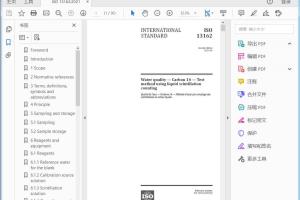
Water quality — Carbon 14 — Test method using liquid scintillation counting由ISO于2021-06发布,适用于世界范围。标准截图

标准文档说明
标准文档类型为Water quality — Carbon 14 — Test method using liquid scintillation counting高清PDF版本(文字版),标准文档内可进行搜索,可以复制原文,可粘贴。标准部分原文
Water quality — Carbon 14 — Test method using liquid scintillation counting
WARNING — Persons using this document should be familiar with normal laboratory practice. This document does not purport to address all of the safety problems, if any, associated with its use. It is the responsibility of the user to establish appropriate safety and health practices and to determine the applicability of any other restrictions.
IMPORTANT — It is absolutely essential that tests conducted according to this document be carried out by suitably trained staff.
1 Scope
14
This document specifies a method for the measurement of C activity concentration in all types of water samples by liquid scintillation counting (LSC) either directly on the test sample or following a chemical separation.
The method is applicable to test samples of supply/drinking water, rainwater, surface and ground water, marine water, as well as cooling water, industrial water, domestic, and industrial wastewater.
The detection limit depends on the sample volume, the instrument used, the sample counting time, the background count rate, the detection efficiency and the chemical recovery. The method described in this document, using currently available liquid scintillation counters and suitable technical conditions, −1
has a detection limit as low as 1 Bq∙l , which is lower than the WHO criteria for safe consumption of -1 14 6 -1
drinking water (100 Bq·l ). C activity concentrations can be measured up to 10 Bq∙l without any sample dilution.
It is the user’s responsibility to ensure the validity of this test method for the water samples tested.
2 Normative references
The following documents are referred to in the text in such a way that some or all of their content constitutes requirements of this document. For dated references, only the edition cited applies. For undated references, the latest edition of the referenced document (including any amendments) applies.
ISO 5667-1, Water quality — Sampling — Part 1: Guidance on the design of sampling programmes and sampling techniques
ISO 5667-3, Water quality — Sampling — Part 3: Preservation and handling of water samples
ISO 5667-10, Water quality — Sampling — Part 10: Guidance on sampling of waste water
ISO 11929-1, Determination of the characteristic limits (decision threshold, detection limit and limits of the coverage interval) for measurements of ionizing radiation — Fundamentals and application — Part 1: Elementary applications
ISO 19361, Measurement of radioactivity — Determination of beta emitters activities — Test method using liquid scintillation counting
ISO 80000-10, Quantities and units — Part 10: Atomic and nuclear physics
ISO/IEC 17025, General requirements for the competence of testing and calibration laboratories
ISO/IEC Guide 98-3:2008, Uncertainty of measurement — Part 3: Guide to the expression of uncertainty in measurement (GUM: 1995) — Part 3: Guide to the expression of uncertainty in measurement (GUM: 1995)
ISO/IEC Guide 99:2007, International vocabulary of metrology — Basic and general concepts and associated terms (VIM)
3 Terms, d efinitions , symbols and abbreviations
For the purposes of this document, the definitions, symbols and abbreviations given in ISO/IEC Guide 99:2007, ISO/IEC Guide 98-3:2008, ISO 80000-10, and the following apply.
ISO and IEC maintain terminological databases for use in standardization at the following addresses:
— ISO Online browsing platform: available at https:// www. iso .org/o bp
— IEC Electropedia: available at http:// www .electropedia .org/ β Maximum energy for the beta emission keV
max
V
Volume of laboratory sample l
m
Mass of laboratory sample kg
-1
ρ
Density of the sample kg∙l
-1
c Activity concentration Bq∙l
A
-1
a
Activity per unit of mass Bq∙kg
A Activity of the calibration source Bq
A Activity of the internal standard solution Bq
s
n Number of counting -
N Number of the counted pulses for the background -
o
t Background counting time, in second s
0
N Number of the counted pulses for the sample -
g
t Sample counting time s
g
t Calibration counting time s
s
-1
r Background count rate s
0
-1
r Test sample count rate s
g
-1
r Calibration count rate s
s
ε
Detection efficiency -
Q Quench parameter -
f Quench factor -
q
ε Counting efficiency at quench parameter Q -
q
R Chemical recovery -
c
m Mass of total carbon in the sample kg
TC
m Mass of carbon in the precipitate kg
PC
m Mass of carbon in the carrier kg
CC
m Mass of sample carbon in the precipitate kg
SC
-1
Standard uncertainty associated with the measurement result Bq∙l
uc()
A
u Relative standard uncertainty -
rel
-1
c Possible or assumed true quantity values of the measurand Bq∙l
A
-1
Standard uncertainty of c Bq∙l
uc()
A
A
α, β Probability of a false positive and false negative decision, respectively -
网盘链接
百度网盘:https://pan.baidu.com/s/1Mds8YgUK00jhy3cId5Lilw
提取码:t9ws
【温馨提示】大资料ISO是提供信息发布的专业信息类网站,所有内容均由用户发布,不代表本站观点,本站亦不存储所涉及的文件及资料。如有【免费资料】以及【付费资料】,请用户根据自己的需求,自行判断是否需要获取。如有交易诈骗、内容侵权可发送邮件至kf@dzl100.com,我们审查后若发现情况属实,会立即对相关内容进行删除处理。
加载用时:51.9237 毫秒
相关评论
相关文章
-
ISO 13162:2021 Water quality — Carbon 14 — Test method using liquid scintillation counting
Water quality — Carbon 14 — Test method using liquid scintillation counting是ISO于2021-06发布的ISO标准,适用于世界范围。本次分享的标准文档为高清PDF(文字版),标准文档内可搜索,可复制,可粘贴。本文结尾附网盘链接。
-

ISO 10014:2021 Quality management systems — Managing an organization for quality results — Guidance for realizing financial and economic benefits
Quality management systems — Managing an organization for quality results — Guidance for realizing financial and economic benefits是国际标准化组织(International Organization for Standardization,简称ISO)于2021-04-20发布的ISO标准,适用于世界范围。本次分享的标准文档为高清PDF(文字版),标准文档内可搜索,可复制,可粘贴。本文结尾附网盘链接。
-

ISO 19475:2021 Document management — Minimum requirements for the storage of documents
Document management — Minimum requirements for the storage of documents是国际标准化组织(International Organization for Standardization,简称ISO)于2021‑06‑10发布的ISO标准,适用于全球。本次分享的标准文档为高清PDF(文字版),标准文档内可搜索,可复制,可粘贴。本文结尾附网盘链接。
-

ISO 19206-3:2021 Road vehicles — Test devices for target vehicles, vulnerable road users and other objects, for assessment of active safety functions —Part 3: Requirements for passenger vehicle 3D targets
Road vehicles — Test devices for target vehicles, vulnerable road users and other objects, for assessment of active safety functions —Part 3: Requirements for passenger vehicle 3D targets是ISO于2021‑05‑21发布的ISO标准,适用于全球范围。本次分享的标准文档为高清PDF(文字版),标准文档内可搜索,可复制,可粘贴。本文结尾附网盘链接。
-

ISO 16355-1:2021 Application of statistical and related methods to new technology and product development process —Part 1: General principles and perspectives of quality function deployment (QFD)
Application of statistical and related methods to new technology and product development process —Part 1: General principles and perspectives of quality function deployment (QFD)是ISO于2021-05发布的ISO标准,适用于世界范围。本次分享的标准文档为高清PDF(文字版),标准文档内可搜索,可复制,可粘贴。本文结尾附网盘链接。
-

ISO 16140-3:2021 Microbiology of the food chain — Method validation —Part 3: Protocol for the verification of reference methods and validated alternative methods in a single laboratory
Microbiology of the food chain — Method validation —Part 3: Protocol for the verification of reference methods and validated alternative methods in a single laboratory是国际标准化组织于2021-01发布的ISO标准,适用于全球。本次分享的标准文档为高清PDF(文字版),标准文档内可搜索,可复制,可粘贴。本文结尾附网盘链接。
-

ISO 16321-1:2021 Eye and face protection for occupational use —Part 1: General requirements
Eye and face protection for occupational use —Part 1: General requirements是ISO于2021-03发布的ISO标准,适用于全球。本次分享的标准文档为高清PDF(文字版),标准文档内可搜索,可复制,可粘贴。本文结尾附网盘链接。
-

ISO 11737-1:2018/Amd.1:2021 Sterilization of health care products — Microbiological methods —Part 1: Determination of a population of microorganisms on products
Sterilization of health care products — Microbiological methods —Part 1: Determination of a population of microorganisms on products是ISO于2018-01发布的ISO标准,适用于全球范围。本次分享的标准文档为高清PDF(文字版),标准文档内可搜索,可复制,可粘贴。本文结尾附网盘链接。
-
ISO 17226-1:2021 INTERNATIONAL STANDARDIULTCS/IUC 19-1:2021(E)Leather — Chemical determination of formaldehyde content —Part 1: Method using high-performance liquid chromatography
INTERNATIONAL STANDARDIULTCS/IUC 19-1:2021(E)Leather — Chemical determination of formaldehyde content —Part 1: Method using high-performance liquid chromatography是国际标准化组织于2021-02发布的ISO标准,适用于国际范围。本次分享的标准文档为高清PDF(文字版),标准文档内可搜索,可复制,可粘贴。本文结尾附网盘链接。
-

ISO 19290:2021 Cigarettes — Determination of tobacco specific nitrosamines in mainstream cigarette smoke — Method using LC-MS/MS
Cigarettes — Determination of tobacco specific nitrosamines in mainstream cigarette smoke — Method using LC-MS/MS是国际标准化组织于2021-02发布的ISO标准,适用于国际范围。本次分享的标准文档为高清PDF(文字版),标准文档内可搜索,可复制,可粘贴。本文结尾附网盘链接。
-

Petroleum and natural gas industries — Site-specific assessment of mobile offshore units —Part 3: Floating units
Petroleum and natural gas industries — Site-specific assessment of mobile offshore units —Part 3: Floating units是国际标准化组织(International Organization for Standardization,简称ISO)于2021-03发布的ISO标准,适用于国际,世界范围。本次分享的标准文档为高清PDF(文字版),标准文档内可搜索,可复制,可粘贴。本文结尾附网盘链接。
-

ISO 10140-1:2021 Acoustics — Laboratory measurement of sound insulation of building elements —Part 1: Application rules for specific products
Acoustics — Laboratory measurement of sound insulation of building elements —Part 1: Application rules for specific products是国际标准化组织(International Organization for Standardization,简称ISO)于2021-05发布的ISO标准,适用于世界范围。本次分享的标准文档为高清PDF(文字版),标准文档内可搜索,可复制,可粘贴。本文结尾附网盘链接。
-

ISO 11665-4:2021 Measurement of radioactivity in the environment — Air: radon-222 —Part 4: Integrated measurement method for determining average activity concentration using passive sampling and delayed analysis
Measurement of radioactivity in the environment — Air: radon-222 —Part 4: Integrated measurement method for determining average activity concentration using passive sampling and delayed analysis是国际标准化组织于2021-03发布的ISO标准,适用于全球。本次分享的标准文档为高清PDF(文字版),标准文档内可搜索,可复制,可粘贴。本文结尾附网盘链接。
-

ISO 14644-17:2021 Cleanrooms and associated controlled environments —Part 17: Particle deposition rate applications
Cleanrooms and associated controlled environments —Part 17: Particle deposition rate applications是国际标准化组织于2021-02发布的ISO标准,适用于全球范围。本次分享的标准文档为高清PDF(文字版),标准文档内可搜索,可复制,可粘贴。本文结尾附网盘链接。
-

ISO 10013:2021 Quality management systems — Guidance for documented information
Quality management systems — Guidance for documented information是国际标准化组织(International Organization for Standardization,简称ISO)于2021-03-09发布的ISO标准,适用于全球范围。本次分享的标准文档为高清PDF(文字版),标准文档内可搜索,可复制,可粘贴。本文结尾附网盘链接。