ISO 16929:2021 Plastics — Determination of the degree of disintegration of plastic materials under defined composting conditions in a pilot-scale test
标准简介
Plastics — Determination of the degree of disintegration of plastic materials under defined composting conditions in a pilot-scale test由ISO于2021-03发布,适用于世界范围。标准截图
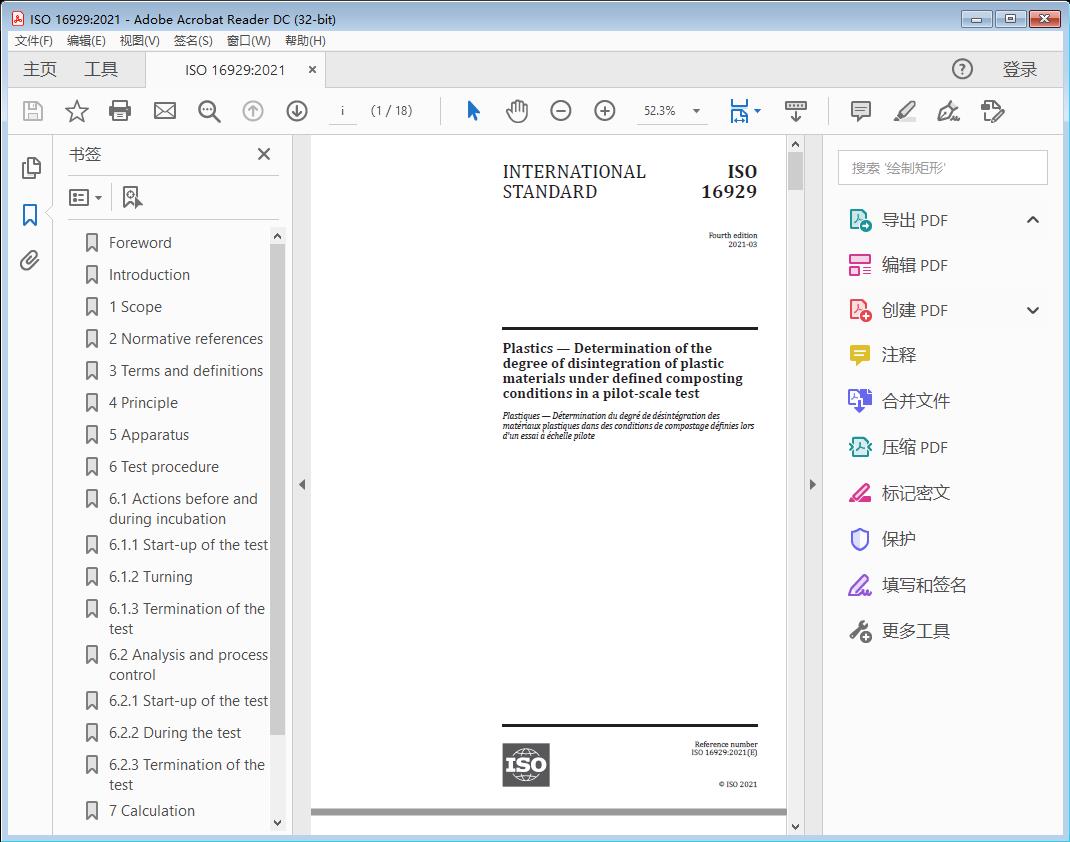
标准文档说明
标准文档类型为Plastics — Determination of the degree of disintegration of plastic materials under defined composting conditions in a pilot-scale test高清PDF版本(文字版),标准文档内可进行搜索,可以复制原文,可粘贴。标准部分原文
Plastics — Determination of the degree of disintegration of plastic materials under defined composting conditions in a pilot-scale test
1 Scope
This document defines a test method used to determine the degree of disintegration of plastic materials in a pilot-scale aerobic composting test under defined conditions. It forms part of an overall scheme for the evaluation of the industrial compostability of plastics as outlined in ISO 17088. The test method laid down in this document is also used to determine the influence of the test material on the composting process and the quality of the compost obtained. This test method cannot be used to determine the aerobic biodegradability of a test material. NOTE Other methods are available for this test (for example, see ISO 14851, ISO 14852 or ISO 14855-1 and ISO 14855-2).
2 Normative references
There are no normative references in this document.
3 Terms and definitions
For the purposes of this document, the following terms and definitions apply.
ISO and IEC maintain terminological databases for use in standardization at the following addresses:
— ISO Online browsing platform: available at https://w ww. iso. org/ obp
— IEC Electropedia: available at http:// www .electropedia. org/ 3.1
degradation
irreversible process leading to a significant change in the structure of a material, typically characterized by a loss of properties (e.g. integrity, molecular mass or structure, mechanical strength) and/or by fragmentation, affected by environmental conditions, proceeding over a period of time and comprising one or more steps
3.2
biodegradation
degradation (3.1) caused by biological activity especially by enzymatic action leading to a significant change in the chemical structure of a material
3.3
disintegration
physical breakdown of a material into very small fragments
3.4
compost
organic soil conditioner obtained by biodegradation (3.2) of a mixture principally consisting of various vegetable residues, occasionally with other organic material, and having a limited mineral content
3.5
composting
aerobic process designed to produce compost (3.4)
3.6
compostability
property of a material to be biodegraded in a composting (3.5) process
3.7
maturity of compost
assignment of the maturity of a compost (3.4) based on the measurement of the maximum temperature in a self-heating test using Dewar vessels
Note 1 to entry: It is expressed in terms of the so-called “Rottegrad” (see 6.2.3.1).
3.8
total dry solids
amount of solids obtained by taking a known volume of test material or compost (3.4) and drying at about 105 °C to constant mass
3.9
volatile solids
amount of solids obtained by subtracting the residues of a known volume of test material or compost (3.4) after incineration at about 550 °C from the total dry solids (3.8) content of the same sample
Note 1 to entry: The volatile solids content is an indication of the amount of organic matter present.
4 Principle
The disintegration test is performed under defined and standardized composting conditions on a pilot-
scale level.
The test material is mixed with fresh biowaste in a precise concentration and introduced into a defined composting environment. A natural ubiquitous microbial population starts the composting process spontaneously and the temperature increases. The composting mass is regularly turned over and mixed. Temperature, pH-value, moisture content and gas composition are regularly monitored. They should fulfil certain requirements to ensure sufficient and appropriate microbial activity. The composting process is continued until a fully stabilized compost is obtained. This is usually the case after 12 weeks.
The compost is visually observed at regular time intervals to detect any adverse effect of the test material on the composting process. At the end of the test, the maturity of compost is determined, and the mixture of compost and test material is sieved through 2 mm and 10 mm mesh sieves. The disintegration of the test material is evaluated based on the total dry solids by comparing the fraction of test material retained by the 2 mm sieve and the amount tested. The compost obtained at the end of the composting process may be used for further measurements, such as chemical analyses and ecotoxicity tests.
5 Apparatus
5.1 Composting environment.
5.1.1 General
The composting environment may be either a pilot-scale composting bin or nets buried in a pilot-scale composting bin. The volume of each bin shall be high enough for natural self-heating to occur. Sufficient and even aeration shall be provided by an appropriate air supply system. To standardize conditions for the test, the composting trials can be run in bins which are placed in a climatic chamber with a constant chamber temperature or in insulated bins.
网盘链接
百度网盘:https://pan.baidu.com/s/1fd1oS4OD-89mfiHoxOVz4A
提取码:daxw
【温馨提示】大资料ISO是提供信息发布的专业信息类网站,所有内容均由用户发布,不代表本站观点,本站亦不存储所涉及的文件及资料。如有【免费资料】以及【付费资料】,请用户根据自己的需求,自行判断是否需要获取。如有交易诈骗、内容侵权可发送邮件至kf@dzl100.com,我们审查后若发现情况属实,会立即对相关内容进行删除处理。
加载用时:39.4873 毫秒
相关评论
相关文章
-

ISO 16929:2021 Plastics — Determination of the degree of disintegration of plastic materials under defined composting conditions in a pilot-scale test
Plastics — Determination of the degree of disintegration of plastic materials under defined composting conditions in a pilot-scale test是ISO于2021-03发布的ISO标准,适用于世界范围。本次分享的标准文档为高清PDF(文字版),标准文档内可搜索,可复制,可粘贴。本文结尾附网盘链接。
-

ISO 10014:2021 Quality management systems — Managing an organization for quality results — Guidance for realizing financial and economic benefits
Quality management systems — Managing an organization for quality results — Guidance for realizing financial and economic benefits是国际标准化组织(International Organization for Standardization,简称ISO)于2021-04-20发布的ISO标准,适用于世界范围。本次分享的标准文档为高清PDF(文字版),标准文档内可搜索,可复制,可粘贴。本文结尾附网盘链接。
-

ISO 19475:2021 Document management — Minimum requirements for the storage of documents
Document management — Minimum requirements for the storage of documents是国际标准化组织(International Organization for Standardization,简称ISO)于2021‑06‑10发布的ISO标准,适用于全球。本次分享的标准文档为高清PDF(文字版),标准文档内可搜索,可复制,可粘贴。本文结尾附网盘链接。
-

ISO 19206-3:2021 Road vehicles — Test devices for target vehicles, vulnerable road users and other objects, for assessment of active safety functions —Part 3: Requirements for passenger vehicle 3D targets
Road vehicles — Test devices for target vehicles, vulnerable road users and other objects, for assessment of active safety functions —Part 3: Requirements for passenger vehicle 3D targets是ISO于2021‑05‑21发布的ISO标准,适用于全球范围。本次分享的标准文档为高清PDF(文字版),标准文档内可搜索,可复制,可粘贴。本文结尾附网盘链接。
-

ISO 16355-1:2021 Application of statistical and related methods to new technology and product development process —Part 1: General principles and perspectives of quality function deployment (QFD)
Application of statistical and related methods to new technology and product development process —Part 1: General principles and perspectives of quality function deployment (QFD)是ISO于2021-05发布的ISO标准,适用于世界范围。本次分享的标准文档为高清PDF(文字版),标准文档内可搜索,可复制,可粘贴。本文结尾附网盘链接。
-

ISO 16140-3:2021 Microbiology of the food chain — Method validation —Part 3: Protocol for the verification of reference methods and validated alternative methods in a single laboratory
Microbiology of the food chain — Method validation —Part 3: Protocol for the verification of reference methods and validated alternative methods in a single laboratory是国际标准化组织于2021-01发布的ISO标准,适用于全球。本次分享的标准文档为高清PDF(文字版),标准文档内可搜索,可复制,可粘贴。本文结尾附网盘链接。
-

ISO 16321-1:2021 Eye and face protection for occupational use —Part 1: General requirements
Eye and face protection for occupational use —Part 1: General requirements是ISO于2021-03发布的ISO标准,适用于全球。本次分享的标准文档为高清PDF(文字版),标准文档内可搜索,可复制,可粘贴。本文结尾附网盘链接。
-

ISO 11737-1:2018/Amd.1:2021 Sterilization of health care products — Microbiological methods —Part 1: Determination of a population of microorganisms on products
Sterilization of health care products — Microbiological methods —Part 1: Determination of a population of microorganisms on products是ISO于2018-01发布的ISO标准,适用于全球范围。本次分享的标准文档为高清PDF(文字版),标准文档内可搜索,可复制,可粘贴。本文结尾附网盘链接。
-
ISO 17226-1:2021 INTERNATIONAL STANDARDIULTCS/IUC 19-1:2021(E)Leather — Chemical determination of formaldehyde content —Part 1: Method using high-performance liquid chromatography
INTERNATIONAL STANDARDIULTCS/IUC 19-1:2021(E)Leather — Chemical determination of formaldehyde content —Part 1: Method using high-performance liquid chromatography是国际标准化组织于2021-02发布的ISO标准,适用于国际范围。本次分享的标准文档为高清PDF(文字版),标准文档内可搜索,可复制,可粘贴。本文结尾附网盘链接。
-

ISO 19290:2021 Cigarettes — Determination of tobacco specific nitrosamines in mainstream cigarette smoke — Method using LC-MS/MS
Cigarettes — Determination of tobacco specific nitrosamines in mainstream cigarette smoke — Method using LC-MS/MS是国际标准化组织于2021-02发布的ISO标准,适用于国际范围。本次分享的标准文档为高清PDF(文字版),标准文档内可搜索,可复制,可粘贴。本文结尾附网盘链接。
-

Petroleum and natural gas industries — Site-specific assessment of mobile offshore units —Part 3: Floating units
Petroleum and natural gas industries — Site-specific assessment of mobile offshore units —Part 3: Floating units是国际标准化组织(International Organization for Standardization,简称ISO)于2021-03发布的ISO标准,适用于国际,世界范围。本次分享的标准文档为高清PDF(文字版),标准文档内可搜索,可复制,可粘贴。本文结尾附网盘链接。
-

ISO 10140-1:2021 Acoustics — Laboratory measurement of sound insulation of building elements —Part 1: Application rules for specific products
Acoustics — Laboratory measurement of sound insulation of building elements —Part 1: Application rules for specific products是国际标准化组织(International Organization for Standardization,简称ISO)于2021-05发布的ISO标准,适用于世界范围。本次分享的标准文档为高清PDF(文字版),标准文档内可搜索,可复制,可粘贴。本文结尾附网盘链接。
-

ISO 11665-4:2021 Measurement of radioactivity in the environment — Air: radon-222 —Part 4: Integrated measurement method for determining average activity concentration using passive sampling and delayed analysis
Measurement of radioactivity in the environment — Air: radon-222 —Part 4: Integrated measurement method for determining average activity concentration using passive sampling and delayed analysis是国际标准化组织于2021-03发布的ISO标准,适用于全球。本次分享的标准文档为高清PDF(文字版),标准文档内可搜索,可复制,可粘贴。本文结尾附网盘链接。
-

ISO 14644-17:2021 Cleanrooms and associated controlled environments —Part 17: Particle deposition rate applications
Cleanrooms and associated controlled environments —Part 17: Particle deposition rate applications是国际标准化组织于2021-02发布的ISO标准,适用于全球范围。本次分享的标准文档为高清PDF(文字版),标准文档内可搜索,可复制,可粘贴。本文结尾附网盘链接。
-

ISO 10013:2021 Quality management systems — Guidance for documented information
Quality management systems — Guidance for documented information是国际标准化组织(International Organization for Standardization,简称ISO)于2021-03-09发布的ISO标准,适用于全球范围。本次分享的标准文档为高清PDF(文字版),标准文档内可搜索,可复制,可粘贴。本文结尾附网盘链接。