ISO 14053:2021 Environmental management — Material flow cost accounting — Guidance for phased implementation in organizations
标准简介
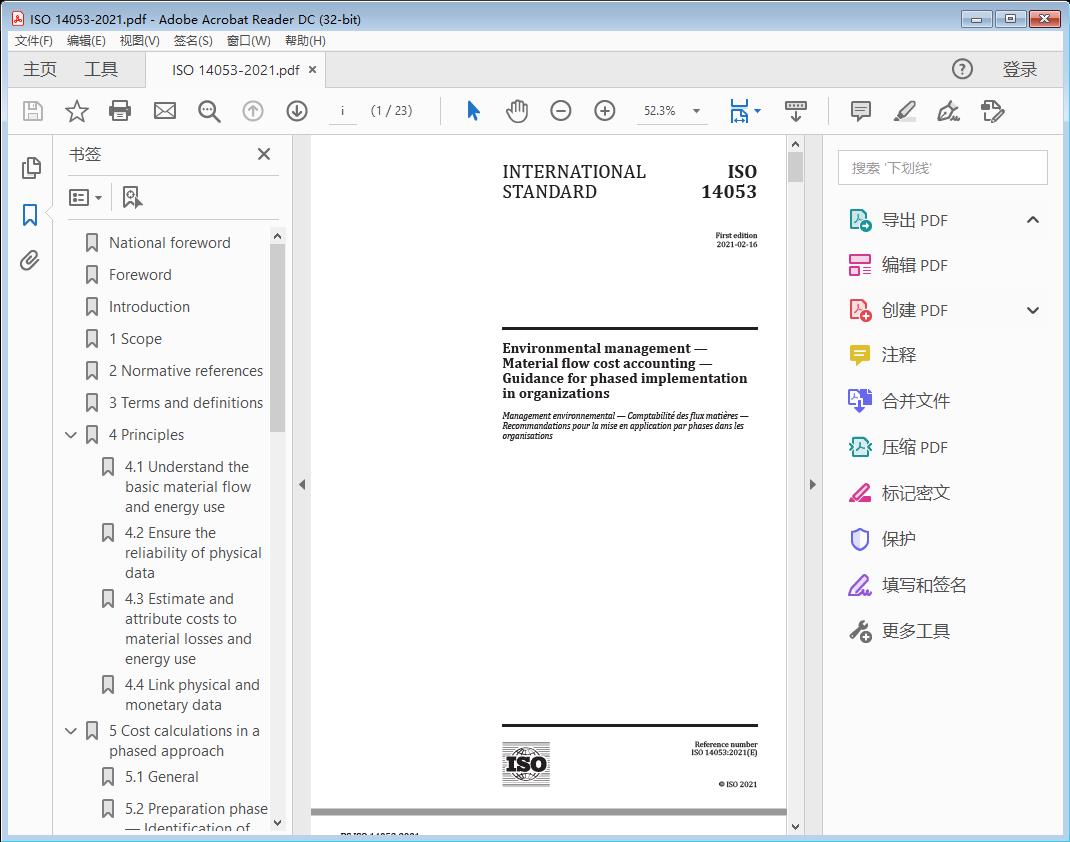
Environmental management — Material flow cost accounting — Guidance for phased implementation in organizations由国际标准化组织于2021-02-16发布,适用于世界范围。标准截图
标准文档说明
标准文档类型为Environmental management — Material flow cost accounting — Guidance for phased implementation in organizations高清PDF版本(文字版),标准文档内可进行搜索,可以复制原文,可粘贴。标准部分原文
INTERNATIONAL STANDARD ISO 14053:2021
Environmental management — Material flow cost accounting — Guidance for phased implementation in organizations
1 Scope
This document gives practical guidelines for the phased implementation of material flow cost accounting (MFCA) that organizations, including small and medium-sized enterprises (SMEs), can adopt to enhance their environmental performance and material efficiency.
The phased approach provides flexibility that allows organizations to develop their MFCA activities at their own pace, according to their own circumstances. The resulting information can act as a motivator for organizations to seek opportunities to simultaneously generate financial and environmental benefits by reducing material losses and energy consumption.
This document is applicable to any organization, regardless of its level of development, the nature of its activities, or the location at which these activities occur.
This document provides basic calculation procedures to analyse saving potentials by avoiding material losses. Detailed calculation procedures or information on techniques for improving material or energy efficiency are out of the scope of this document.
2 Normative references
There are no normative references in this document.
3 Terms and definitions
For the purpose of this document, the following terms and definitions apply.
ISO and IEC maintain terminological databases for use in standardization at the following addresses:
— ISO Online browsing platform: available at https://www.iso.org/obp
— IEC Electropedia: available at http://www.electropedia.org/
3.1
energy cost
cost for electricity, fuels, steam, heat, compressed air and other like media
Note 1 to entry: Energy cost can be either included under material cost or quantified separately, at the discretion of the organization.
[SOURCE: ISO 14051:2011, 3.4]
3.2
energy use
application of energy
EXAMPLE Ventilation; lighting; heating; cooling; transportation; data storage; production process.
Note 1 to entry: Energy use is sometimes referred to as “energy end-use”.
[SOURCE: ISO 50001:2018, 3.5.4]
ISO 14053:2021
3.3
material
substance that enters and/or leaves a process
Note 1 to entry: Materials can be divided into two categories:
— materials that are intended to become part of products, e.g. raw materials, auxiliary materials, intermediate products;
— materials that do not become part of products, e.g. cleaning solvents and chemical catalysts, which often are referred to as operating materials.
Note 2 to entry: Some types of materials can be classified into either category, depending on their use. Water is one such material. In some cases, water can become part of a product (e.g. bottled water), while in other cases it can be used as an operating material (e.g. water used in an equipment washing process).
Note 3 to entry: Energy carriers like fuels or steam can be identified as materials, at the discretion of the organization.
[SOURCE: ISO 14051:2011, 3.10, modified — "quantity centre" changed to "process".]
3.4
material flow cost accounting summary sheet
MFCA summary sheet
spreadsheet that reflects the MFCA (3.6) information for a production process that is treated as a single process
3.5
material cost
cost for a substance that enters and/or leaves a process
Note 1 to entry: Material cost can be calculated in various ways, e.g. standard cost, average cost, and purchase cost. The choice between cost calculation methods is at the discretion of the organization.
[SOURCE: ISO 14051:2011, 3.12, modified — "quantity centre" changed to "process".]
3.6
material flow cost accounting
MFCA
tool for quantifying the flows and stocks of materials (3.3) in processes or production lines in both physical and monetary units
[SOURCE: ISO 14051:2011, 3.15]
3.7
material loss
all material outputs generated in a process, except for intended products
Note 1 to entry: Material losses include air emissions, wastewater and solid waste, even if these material outputs can be reworked, recycled or reused internally, or have market value.
Note 2 to entry: By-products can be considered as either material losses or products, at the discretion of the organization.
[SOURCE: ISO 14051:2011, 3.16, modified — "quantity centre" changed to "process".]
3.8
system cost
cost incurred in the course of in-house handling of the material (3.3) flows, except for material cost (3.5), energy cost (3.1) and waste management cost (3.9)
EXAMPLE Cost of labour; cost of depreciation and maintenance; cost of transport.
[SOURCE: ISO 14051:2011, 3.21]
网盘链接
百度网盘:https://pan.baidu.com/s/1N_IcFxdmz8Ux4CRze7rM8w
提取码:twtt
【温馨提示】大资料ISO是提供信息发布的专业信息类网站,所有内容均由用户发布,不代表本站观点,本站亦不存储所涉及的文件及资料。如有【免费资料】以及【付费资料】,请用户根据自己的需求,自行判断是否需要获取。如有交易诈骗、内容侵权可发送邮件至kf@dzl100.com,我们审查后若发现情况属实,会立即对相关内容进行删除处理。
加载用时:60.8384 毫秒
相关评论
相关文章
-
ISO 14053:2021 Environmental management — Material flow cost accounting — Guidance for phased implementation in organizations
Environmental management — Material flow cost accounting — Guidance for phased implementation in organizations是国际标准化组织于2021-02-16发布的ISO标准,适用于世界范围。本次分享的标准文档为高清PDF(文字版),标准文档内可搜索,可复制,可粘贴。本文结尾附网盘链接。
-

ISO 10014:2021 Quality management systems — Managing an organization for quality results — Guidance for realizing financial and economic benefits
Quality management systems — Managing an organization for quality results — Guidance for realizing financial and economic benefits是国际标准化组织(International Organization for Standardization,简称ISO)于2021-04-20发布的ISO标准,适用于世界范围。本次分享的标准文档为高清PDF(文字版),标准文档内可搜索,可复制,可粘贴。本文结尾附网盘链接。
-

ISO 19475:2021 Document management — Minimum requirements for the storage of documents
Document management — Minimum requirements for the storage of documents是国际标准化组织(International Organization for Standardization,简称ISO)于2021‑06‑10发布的ISO标准,适用于全球。本次分享的标准文档为高清PDF(文字版),标准文档内可搜索,可复制,可粘贴。本文结尾附网盘链接。
-

ISO 19206-3:2021 Road vehicles — Test devices for target vehicles, vulnerable road users and other objects, for assessment of active safety functions —Part 3: Requirements for passenger vehicle 3D targets
Road vehicles — Test devices for target vehicles, vulnerable road users and other objects, for assessment of active safety functions —Part 3: Requirements for passenger vehicle 3D targets是ISO于2021‑05‑21发布的ISO标准,适用于全球范围。本次分享的标准文档为高清PDF(文字版),标准文档内可搜索,可复制,可粘贴。本文结尾附网盘链接。
-

ISO 16355-1:2021 Application of statistical and related methods to new technology and product development process —Part 1: General principles and perspectives of quality function deployment (QFD)
Application of statistical and related methods to new technology and product development process —Part 1: General principles and perspectives of quality function deployment (QFD)是ISO于2021-05发布的ISO标准,适用于世界范围。本次分享的标准文档为高清PDF(文字版),标准文档内可搜索,可复制,可粘贴。本文结尾附网盘链接。
-

ISO 16140-3:2021 Microbiology of the food chain — Method validation —Part 3: Protocol for the verification of reference methods and validated alternative methods in a single laboratory
Microbiology of the food chain — Method validation —Part 3: Protocol for the verification of reference methods and validated alternative methods in a single laboratory是国际标准化组织于2021-01发布的ISO标准,适用于全球。本次分享的标准文档为高清PDF(文字版),标准文档内可搜索,可复制,可粘贴。本文结尾附网盘链接。
-

ISO 16321-1:2021 Eye and face protection for occupational use —Part 1: General requirements
Eye and face protection for occupational use —Part 1: General requirements是ISO于2021-03发布的ISO标准,适用于全球。本次分享的标准文档为高清PDF(文字版),标准文档内可搜索,可复制,可粘贴。本文结尾附网盘链接。
-

ISO 11737-1:2018/Amd.1:2021 Sterilization of health care products — Microbiological methods —Part 1: Determination of a population of microorganisms on products
Sterilization of health care products — Microbiological methods —Part 1: Determination of a population of microorganisms on products是ISO于2018-01发布的ISO标准,适用于全球范围。本次分享的标准文档为高清PDF(文字版),标准文档内可搜索,可复制,可粘贴。本文结尾附网盘链接。
-
ISO 17226-1:2021 INTERNATIONAL STANDARDIULTCS/IUC 19-1:2021(E)Leather — Chemical determination of formaldehyde content —Part 1: Method using high-performance liquid chromatography
INTERNATIONAL STANDARDIULTCS/IUC 19-1:2021(E)Leather — Chemical determination of formaldehyde content —Part 1: Method using high-performance liquid chromatography是国际标准化组织于2021-02发布的ISO标准,适用于国际范围。本次分享的标准文档为高清PDF(文字版),标准文档内可搜索,可复制,可粘贴。本文结尾附网盘链接。
-

ISO 19290:2021 Cigarettes — Determination of tobacco specific nitrosamines in mainstream cigarette smoke — Method using LC-MS/MS
Cigarettes — Determination of tobacco specific nitrosamines in mainstream cigarette smoke — Method using LC-MS/MS是国际标准化组织于2021-02发布的ISO标准,适用于国际范围。本次分享的标准文档为高清PDF(文字版),标准文档内可搜索,可复制,可粘贴。本文结尾附网盘链接。
-

Petroleum and natural gas industries — Site-specific assessment of mobile offshore units —Part 3: Floating units
Petroleum and natural gas industries — Site-specific assessment of mobile offshore units —Part 3: Floating units是国际标准化组织(International Organization for Standardization,简称ISO)于2021-03发布的ISO标准,适用于国际,世界范围。本次分享的标准文档为高清PDF(文字版),标准文档内可搜索,可复制,可粘贴。本文结尾附网盘链接。
-

ISO 10140-1:2021 Acoustics — Laboratory measurement of sound insulation of building elements —Part 1: Application rules for specific products
Acoustics — Laboratory measurement of sound insulation of building elements —Part 1: Application rules for specific products是国际标准化组织(International Organization for Standardization,简称ISO)于2021-05发布的ISO标准,适用于世界范围。本次分享的标准文档为高清PDF(文字版),标准文档内可搜索,可复制,可粘贴。本文结尾附网盘链接。
-

ISO 11665-4:2021 Measurement of radioactivity in the environment — Air: radon-222 —Part 4: Integrated measurement method for determining average activity concentration using passive sampling and delayed analysis
Measurement of radioactivity in the environment — Air: radon-222 —Part 4: Integrated measurement method for determining average activity concentration using passive sampling and delayed analysis是国际标准化组织于2021-03发布的ISO标准,适用于全球。本次分享的标准文档为高清PDF(文字版),标准文档内可搜索,可复制,可粘贴。本文结尾附网盘链接。
-

ISO 14644-17:2021 Cleanrooms and associated controlled environments —Part 17: Particle deposition rate applications
Cleanrooms and associated controlled environments —Part 17: Particle deposition rate applications是国际标准化组织于2021-02发布的ISO标准,适用于全球范围。本次分享的标准文档为高清PDF(文字版),标准文档内可搜索,可复制,可粘贴。本文结尾附网盘链接。
-

ISO 10013:2021 Quality management systems — Guidance for documented information
Quality management systems — Guidance for documented information是国际标准化组织(International Organization for Standardization,简称ISO)于2021-03-09发布的ISO标准,适用于全球范围。本次分享的标准文档为高清PDF(文字版),标准文档内可搜索,可复制,可粘贴。本文结尾附网盘链接。