ISO 18527-1:2021 Eye and face protection for sports use —Part 1: Requirements for downhill skiing and snowboarding goggles
标准简介
Eye and face protection for sports use —Part 1: Requirements for downhill skiing and snowboarding goggles由国际标准化组织于2021-03发布,适用于国际范围。标准截图
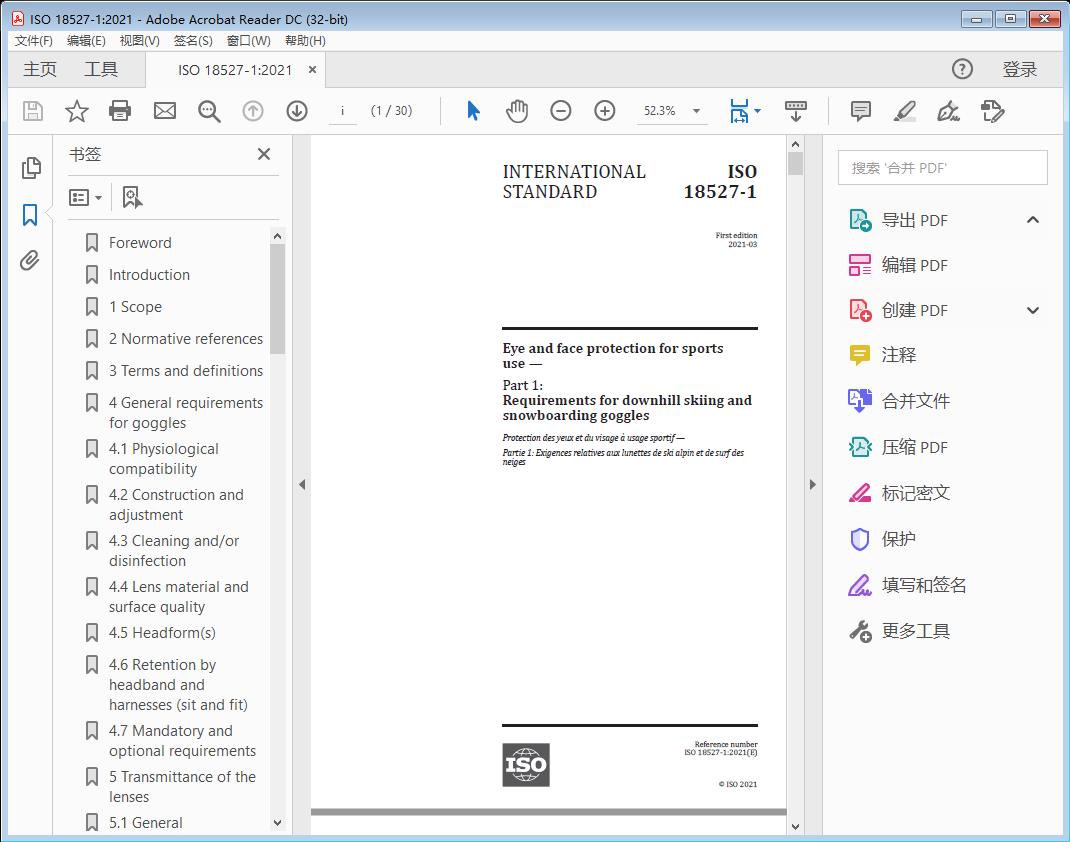
标准文档说明
标准文档类型为Eye and face protection for sports use —Part 1: Requirements for downhill skiing and snowboarding goggles高清PDF版本(文字版),标准文档内可进行搜索,可以复制原文,可粘贴。标准部分原文
Eye and face protection for sports use —
Part 1: Requirements for downhill skiing and snowboarding goggles
1 Scope
This document applies to all goggles with plano lenses, intended for eye protection against hazards including ultraviolet and visible solar radiation, rain, snow and wind, during downhill skiing, snowboarding and other similar activities.
This document applies to downhill skiing and snowboarding goggles fitted with an insert to carry prescription lenses.
It specifies requirements and testing for materials, performance, marking of goggles and information to be supplied by the manufacturer.
Information on the selection and use of downhill skiing and snowboarding goggles is given in Annex A.
This document does not apply to
a) eye protectors for protection when operating or travelling on a motorized vehicle,
b) eye protectors for protection against optical radiation from artificial sources, such as those used in solaria,
c) eye protectors for direct observation of the sun, and
d) eye protectors intended for sports with unrelated hazards and risks.
2 Normative references
The following documents are referred to in the text in such a way that some or all of their content constitutes requirements of this document. For dated references, only the edition cited applies. For undated references, the latest edition of the referenced document (including any amendments) applies.
ISO 4007, Personal protective equipment — Eye and face protection — Vocabulary
ISO 8980-5, Ophthalmic optics — Uncut finished spectacle lenses — Part 5: Minimum requirements for spectacle lens surfaces claimed to be abrasion-resistant
ISO 11664-2, Colorimetry — Part 2: CIE standard illuminants
ISO 18526-1:2020, Eye and face protection — Test methods — Part 1: Geometrical optical properties
ISO 18526-2:2020, Eye and face protection — Test methods — Part 2: Physical optical properties
ISO 18526-3:2020, Eye and face protection — Test methods — Part 3: Physical and mechanical properties
ISO 18526-4, Eye and face protection — Test methods — Part 4: Headforms
ISO 21987, Ophthalmic optics — Mounted spectacle lenses
3 Terms a nd definiti ons
For the purposes of this document, the terms and the definitions given in ISO 4007 apply.
ISO and IEC maintain terminological databases for use in standardization at the following addresses:
— ISO Online browsing platform: available at https:// www .iso .org/ obp
— IEC Electropedia: available at http:// www .electropedia .org/ 4 General requirements for goggles
4.1 Physiological compatibility
Goggles shall be designed and manufactured in such a way that, when used under the conditions and for the purposes intended, they will not compromise the health or safety of the wearer. The risks posed by substances leaking or evaporating from the goggles that can come into prolonged contact with the wearer shall be reduced by the manufacturer to within the limits of any applicable regulatory requirement.
Special attention shall be given to substances that are allergenic, carcinogenic, mutagenic or toxic to reproduction.
NOTE 1 Excessive pressure due to a poor fit on the head, chemical irritation or allergy are known to produce reactions. Rare or idiosyncratic reactions to any material are known to occur and the individual wearer is well advised to avoid those types of frame materials.
Substances recommended for cleaning, maintenance or disinfection shall be known to be unlikely to have any adverse effect upon the wearer, when applied in accordance with the instructions given in the information to be supplied by the manufacturer.
Manufacturers/suppliers shall perform an appropriate risk analysis on potentially harmful substances contained in the goggles such that, when the goggles are used under the conditions and for the purposes intended, the health (and safety) of the wearer shall not be compromised.
The following are examples of documents that represent the appropriate information:
a) specification of the material(s);
b) safety data sheets relating to the materials;
c) information relating to the suitability of the materials for use with food, in medical devices, or other relevant applications;
d) information relating to toxicological, allergenic, carcinogenic, toxic to reproduction, or mutagenic investigations on the materials.
NOTE 2 Specific national regulations with regard to the restriction of certain chemical substances need to be observed, for example release of nickel.
4.2 Construction and adjustment
Areas of the goggles that may, during intended use, come into contact with the wearer shall be free from projections, sharp edges or other features likely to cause discomfort or injury to the wearer.
Any part of the goggles that can be adjusted or removed by the wearer for the purpose of replacement (in accordance with the instructions given in the information to be supplied by the manufacturer) shall facilitate adjustment, removal and attachment without the use of tools.
Any adjustment system incorporated in the goggles shall maintain the intended fit for the foreseeable conditions of use.
网盘链接
百度网盘:https://pan.baidu.com/s/1bQMiKMXrlig_gFFXynlbSQ
提取码:gp2y
【温馨提示】大资料ISO是提供信息发布的专业信息类网站,所有内容均由用户发布,不代表本站观点,本站亦不存储所涉及的文件及资料。如有【免费资料】以及【付费资料】,请用户根据自己的需求,自行判断是否需要获取。如有交易诈骗、内容侵权可发送邮件至kf@dzl100.com,我们审查后若发现情况属实,会立即对相关内容进行删除处理。
加载用时:67.8011 毫秒
相关评论
相关文章
-
ISO 18527-1:2021 Eye and face protection for sports use —Part 1: Requirements for downhill skiing and snowboarding goggles
Eye and face protection for sports use —Part 1: Requirements for downhill skiing and snowboarding goggles是国际标准化组织于2021-03发布的ISO标准,适用于国际范围。本次分享的标准文档为高清PDF(文字版),标准文档内可搜索,可复制,可粘贴。本文结尾附网盘链接。
-

ISO 10014:2021 Quality management systems — Managing an organization for quality results — Guidance for realizing financial and economic benefits
Quality management systems — Managing an organization for quality results — Guidance for realizing financial and economic benefits是国际标准化组织(International Organization for Standardization,简称ISO)于2021-04-20发布的ISO标准,适用于世界范围。本次分享的标准文档为高清PDF(文字版),标准文档内可搜索,可复制,可粘贴。本文结尾附网盘链接。
-

ISO 19475:2021 Document management — Minimum requirements for the storage of documents
Document management — Minimum requirements for the storage of documents是国际标准化组织(International Organization for Standardization,简称ISO)于2021‑06‑10发布的ISO标准,适用于全球。本次分享的标准文档为高清PDF(文字版),标准文档内可搜索,可复制,可粘贴。本文结尾附网盘链接。
-

ISO 19206-3:2021 Road vehicles — Test devices for target vehicles, vulnerable road users and other objects, for assessment of active safety functions —Part 3: Requirements for passenger vehicle 3D targets
Road vehicles — Test devices for target vehicles, vulnerable road users and other objects, for assessment of active safety functions —Part 3: Requirements for passenger vehicle 3D targets是ISO于2021‑05‑21发布的ISO标准,适用于全球范围。本次分享的标准文档为高清PDF(文字版),标准文档内可搜索,可复制,可粘贴。本文结尾附网盘链接。
-

ISO 16355-1:2021 Application of statistical and related methods to new technology and product development process —Part 1: General principles and perspectives of quality function deployment (QFD)
Application of statistical and related methods to new technology and product development process —Part 1: General principles and perspectives of quality function deployment (QFD)是ISO于2021-05发布的ISO标准,适用于世界范围。本次分享的标准文档为高清PDF(文字版),标准文档内可搜索,可复制,可粘贴。本文结尾附网盘链接。
-

ISO 16140-3:2021 Microbiology of the food chain — Method validation —Part 3: Protocol for the verification of reference methods and validated alternative methods in a single laboratory
Microbiology of the food chain — Method validation —Part 3: Protocol for the verification of reference methods and validated alternative methods in a single laboratory是国际标准化组织于2021-01发布的ISO标准,适用于全球。本次分享的标准文档为高清PDF(文字版),标准文档内可搜索,可复制,可粘贴。本文结尾附网盘链接。
-

ISO 16321-1:2021 Eye and face protection for occupational use —Part 1: General requirements
Eye and face protection for occupational use —Part 1: General requirements是ISO于2021-03发布的ISO标准,适用于全球。本次分享的标准文档为高清PDF(文字版),标准文档内可搜索,可复制,可粘贴。本文结尾附网盘链接。
-

ISO 11737-1:2018/Amd.1:2021 Sterilization of health care products — Microbiological methods —Part 1: Determination of a population of microorganisms on products
Sterilization of health care products — Microbiological methods —Part 1: Determination of a population of microorganisms on products是ISO于2018-01发布的ISO标准,适用于全球范围。本次分享的标准文档为高清PDF(文字版),标准文档内可搜索,可复制,可粘贴。本文结尾附网盘链接。
-
ISO 17226-1:2021 INTERNATIONAL STANDARDIULTCS/IUC 19-1:2021(E)Leather — Chemical determination of formaldehyde content —Part 1: Method using high-performance liquid chromatography
INTERNATIONAL STANDARDIULTCS/IUC 19-1:2021(E)Leather — Chemical determination of formaldehyde content —Part 1: Method using high-performance liquid chromatography是国际标准化组织于2021-02发布的ISO标准,适用于国际范围。本次分享的标准文档为高清PDF(文字版),标准文档内可搜索,可复制,可粘贴。本文结尾附网盘链接。
-

ISO 19290:2021 Cigarettes — Determination of tobacco specific nitrosamines in mainstream cigarette smoke — Method using LC-MS/MS
Cigarettes — Determination of tobacco specific nitrosamines in mainstream cigarette smoke — Method using LC-MS/MS是国际标准化组织于2021-02发布的ISO标准,适用于国际范围。本次分享的标准文档为高清PDF(文字版),标准文档内可搜索,可复制,可粘贴。本文结尾附网盘链接。
-

Petroleum and natural gas industries — Site-specific assessment of mobile offshore units —Part 3: Floating units
Petroleum and natural gas industries — Site-specific assessment of mobile offshore units —Part 3: Floating units是国际标准化组织(International Organization for Standardization,简称ISO)于2021-03发布的ISO标准,适用于国际,世界范围。本次分享的标准文档为高清PDF(文字版),标准文档内可搜索,可复制,可粘贴。本文结尾附网盘链接。
-

ISO 10140-1:2021 Acoustics — Laboratory measurement of sound insulation of building elements —Part 1: Application rules for specific products
Acoustics — Laboratory measurement of sound insulation of building elements —Part 1: Application rules for specific products是国际标准化组织(International Organization for Standardization,简称ISO)于2021-05发布的ISO标准,适用于世界范围。本次分享的标准文档为高清PDF(文字版),标准文档内可搜索,可复制,可粘贴。本文结尾附网盘链接。
-

ISO 11665-4:2021 Measurement of radioactivity in the environment — Air: radon-222 —Part 4: Integrated measurement method for determining average activity concentration using passive sampling and delayed analysis
Measurement of radioactivity in the environment — Air: radon-222 —Part 4: Integrated measurement method for determining average activity concentration using passive sampling and delayed analysis是国际标准化组织于2021-03发布的ISO标准,适用于全球。本次分享的标准文档为高清PDF(文字版),标准文档内可搜索,可复制,可粘贴。本文结尾附网盘链接。
-

ISO 14644-17:2021 Cleanrooms and associated controlled environments —Part 17: Particle deposition rate applications
Cleanrooms and associated controlled environments —Part 17: Particle deposition rate applications是国际标准化组织于2021-02发布的ISO标准,适用于全球范围。本次分享的标准文档为高清PDF(文字版),标准文档内可搜索,可复制,可粘贴。本文结尾附网盘链接。
-

ISO 10013:2021 Quality management systems — Guidance for documented information
Quality management systems — Guidance for documented information是国际标准化组织(International Organization for Standardization,简称ISO)于2021-03-09发布的ISO标准,适用于全球范围。本次分享的标准文档为高清PDF(文字版),标准文档内可搜索,可复制,可粘贴。本文结尾附网盘链接。