ISO 14097:2021 Greenhouse gas management and related activities — Framework including principles and requirements for assessing and reporting investments and financing activities related to climate change
标准简介
Greenhouse gas management and related activities — Framework including principles and requirements for assessing and reporting investments and financing activities related to climate change是国际标准化组织(International Organization for Standardization,简称ISO)于2021-05发布的ISO标准,适用于全球范围。标准截图
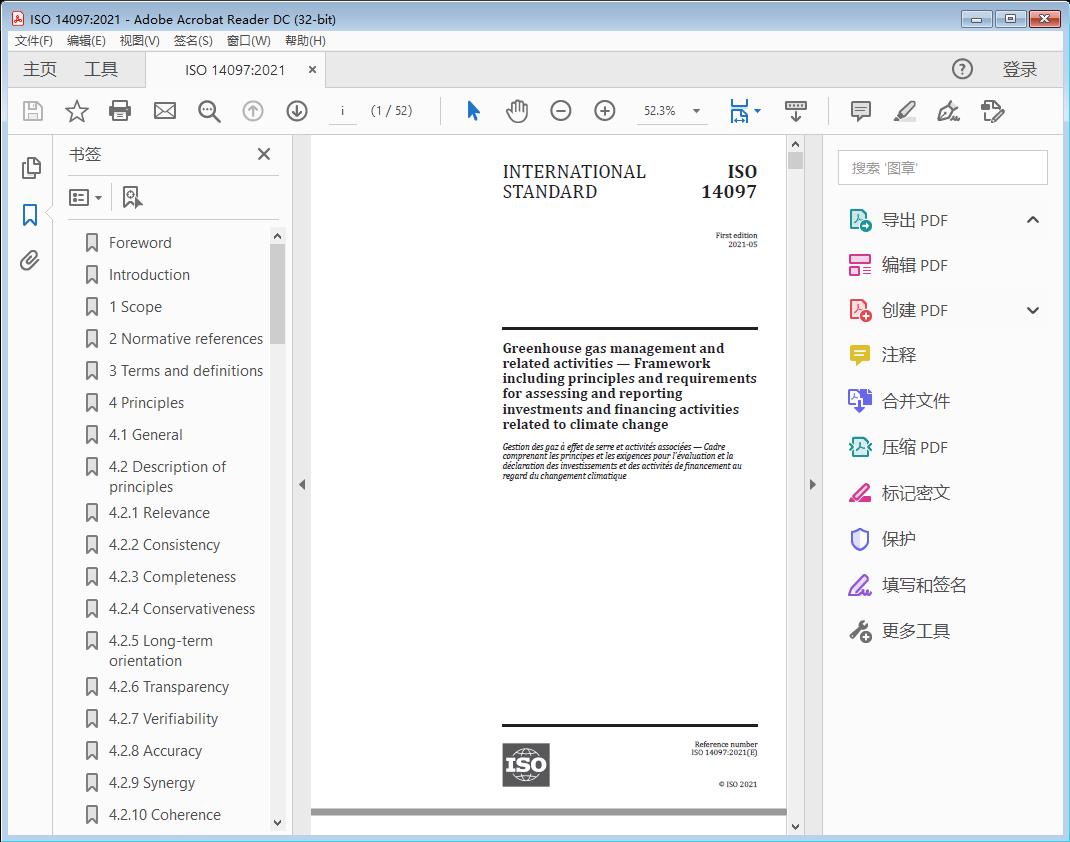
标准文档说明
标准文档类型为Greenhouse gas management and related activities — Framework including principles and requirements for assessing and reporting investments and financing activities related to climate change高清PDF版本(文字版),标准文档内可进行搜索,可以复制原文,可粘贴。标准部分原文
Greenhouse gas management and related activities — Framework including principles and requirements for assessing and reporting investments and financing activities related to climate change
1 Scope
This document specifies a general framework, including principles, requirements and guidance for assessing, measuring, monitoring and reporting on investments and financing activities in relation to climate change and the transition into a low-carbon economy. The assessment includes the following items:
— the alignment (or lack thereof) of investment and financing decisions taken by the financier with low-carbon transition pathways, adaptation pathways, and climate goals;
— the impact of actions through the financier’s investment and lending decisions towards the achievement of climate goals in the real economy, i.e. mitigation (greenhouse gas emissions) and adaptation (resilience);
— the risks to owners of financial assets (e.g. private equities, listed stocks, bonds, loans) arising from climate change.
To support the financier’s assessment of the impact of investment and lending decisions, this document provides guidance for the financier on how to:
— set targets and determine metrics to be used for tracking progress related to the low-carbon transition pathways of investees;
— determine low-carbon transition and adaptation trajectories of investees;
— document the causality or linkage between its climate action and its outputs, outcomes and impacts.
This document is applicable to financiers, i.e. investors and lenders. It guides their reporting activities to the following third parties: shareholders, clients, policymakers, financial supervisory authorities and non-governmental organizations.
2 Normative references
There are no normative references in this document.
3 Terms and definitions
For the purposes of this document, the following terms and definitions apply.
ISO and IEC maintain terminological databases for use in standardization at the following addresses:
— ISO Online browsing platform: available at https://w ww. iso. org/o bp
— IEC Electropedia: available at http://w ww.e lectropedia .org/
3.1
climate goals
international long-term goals based on mitigation and adaptation priorities
Note 1 to entry: International climate goals are defined under the Paris Agreement.
Note 2 to entry: The Paris Agreement defines the following mitigation and adaptation goals: a) holding the increase in the global average temperature to well below 2 °C above pre-industrial levels and pursuing efforts to limit the temperature increase to 1,5 °C above pre-industrial levels, recognizing that this would significantly reduce the risks and impacts of climate change (3.2); b) increasing the ability to adapt to the adverse impacts of climate change and foster climate resilience (3.5) and low greenhouse gas emissions development, in a manner which does not threaten food production; c) making finance flows aligned with a pathway towards low greenhouse gas emissions and climate-resilient development.
[12]
[SOURCE: Paris Agreement , Article 2.1]
3.2
climate change
change in climate that persists for an extended period, typically decades or longer
[15]
[SOURCE: Intergovernmental Panel on Climate Change (IPCC) , modified]
3.3
climate change mitigation
human intervention to reduce the emission sources or enhance the sinks of greenhouse gases (GHGs)
[SOURCE: ISO 14080:2018, 3.1.2.1, modified — The word “emission” has been added to the definition.]
3.4
climate change adaptation
adaptation to climate change
process of adjustment to actual or expected climate and its effects
EXAMPLE Changes to human infrastructure and/or some natural systems to reduce the impacts of increased/decreased rainfall, higher temperatures, scarce water or more frequent storms.
Note 1 to entry: In human systems, adaptation seeks to moderate or avoid harm to human livelihoods or exploit beneficial economic opportunities (3.13).
Note 2 to entry: In some natural systems, human intervention can facilitate adjustment expected climate and its effects.
[SOURCE: ISO 14090:2019, 3.1, modified — The term “climate change adaptation” has been made the preferred term, the example has been added, and “to human livelihoods” and “economic” have been added to Note 1 to entry.]
3.5
resilience
adaptive capacity (3.6) of an organization in a complex and changing environment
[15]
Note 1 to entry: Intergovernmental Panel on Climate Change (IPCC) defines resilience as “capacity of social, economic, and environmental systems to cope with a hazardous event or trend or disturbance, responding or reorganizing in ways that maintain their essential function, identity and structure, while also maintaining the capacity for adaptation, learning and transformation”.
[SOURCE: ISO Guide 73:2009, 3.8.1.7, modified — Note 1 to entry has been added.]
3.6
adaptive capacity
ability of systems, institutions, humans and other organisms to adjust to potential damage, to take advantage of opportunities (3.13) or to respond to consequences
[15]
[SOURCE: Intergovernmental Panel on Climate Change (IPCC) ]
网盘链接
百度网盘:https://pan.baidu.com/s/1BoafAvlHvBWvX_G-IZZu1w
提取码:bkwc
【温馨提示】大资料ISO是提供信息发布的专业信息类网站,所有内容均由用户发布,不代表本站观点,本站亦不存储所涉及的文件及资料。如有【免费资料】以及【付费资料】,请用户根据自己的需求,自行判断是否需要获取。如有交易诈骗、内容侵权可发送邮件至kf@dzl100.com,我们审查后若发现情况属实,会立即对相关内容进行删除处理。
加载用时:58.3994 毫秒
相关评论
相关文章
-
ISO 14097:2021 Greenhouse gas management and related activities — Framework including principles and requirements for assessing and reporting investments and financing activities related to climate change
Greenhouse gas management and related activities — Framework including principles and requirements for assessing and reporting investments and financing activities related to climate change是国际标准化组织(International Organization for Standardization,简称ISO)于2021-05发布的ISO标准,适用于全球范围。本次分享的标准文档为高清PDF(文字版),标准文档内可搜索,可复制,可粘贴。本文结尾附网盘链接。
-

ISO 10014:2021 Quality management systems — Managing an organization for quality results — Guidance for realizing financial and economic benefits
Quality management systems — Managing an organization for quality results — Guidance for realizing financial and economic benefits是国际标准化组织(International Organization for Standardization,简称ISO)于2021-04-20发布的ISO标准,适用于世界范围。本次分享的标准文档为高清PDF(文字版),标准文档内可搜索,可复制,可粘贴。本文结尾附网盘链接。
-

ISO 19475:2021 Document management — Minimum requirements for the storage of documents
Document management — Minimum requirements for the storage of documents是国际标准化组织(International Organization for Standardization,简称ISO)于2021‑06‑10发布的ISO标准,适用于全球。本次分享的标准文档为高清PDF(文字版),标准文档内可搜索,可复制,可粘贴。本文结尾附网盘链接。
-

ISO 19206-3:2021 Road vehicles — Test devices for target vehicles, vulnerable road users and other objects, for assessment of active safety functions —Part 3: Requirements for passenger vehicle 3D targets
Road vehicles — Test devices for target vehicles, vulnerable road users and other objects, for assessment of active safety functions —Part 3: Requirements for passenger vehicle 3D targets是ISO于2021‑05‑21发布的ISO标准,适用于全球范围。本次分享的标准文档为高清PDF(文字版),标准文档内可搜索,可复制,可粘贴。本文结尾附网盘链接。
-

ISO 16355-1:2021 Application of statistical and related methods to new technology and product development process —Part 1: General principles and perspectives of quality function deployment (QFD)
Application of statistical and related methods to new technology and product development process —Part 1: General principles and perspectives of quality function deployment (QFD)是ISO于2021-05发布的ISO标准,适用于世界范围。本次分享的标准文档为高清PDF(文字版),标准文档内可搜索,可复制,可粘贴。本文结尾附网盘链接。
-

ISO 16140-3:2021 Microbiology of the food chain — Method validation —Part 3: Protocol for the verification of reference methods and validated alternative methods in a single laboratory
Microbiology of the food chain — Method validation —Part 3: Protocol for the verification of reference methods and validated alternative methods in a single laboratory是国际标准化组织于2021-01发布的ISO标准,适用于全球。本次分享的标准文档为高清PDF(文字版),标准文档内可搜索,可复制,可粘贴。本文结尾附网盘链接。
-

ISO 16321-1:2021 Eye and face protection for occupational use —Part 1: General requirements
Eye and face protection for occupational use —Part 1: General requirements是ISO于2021-03发布的ISO标准,适用于全球。本次分享的标准文档为高清PDF(文字版),标准文档内可搜索,可复制,可粘贴。本文结尾附网盘链接。
-

ISO 11737-1:2018/Amd.1:2021 Sterilization of health care products — Microbiological methods —Part 1: Determination of a population of microorganisms on products
Sterilization of health care products — Microbiological methods —Part 1: Determination of a population of microorganisms on products是ISO于2018-01发布的ISO标准,适用于全球范围。本次分享的标准文档为高清PDF(文字版),标准文档内可搜索,可复制,可粘贴。本文结尾附网盘链接。
-
ISO 17226-1:2021 INTERNATIONAL STANDARDIULTCS/IUC 19-1:2021(E)Leather — Chemical determination of formaldehyde content —Part 1: Method using high-performance liquid chromatography
INTERNATIONAL STANDARDIULTCS/IUC 19-1:2021(E)Leather — Chemical determination of formaldehyde content —Part 1: Method using high-performance liquid chromatography是国际标准化组织于2021-02发布的ISO标准,适用于国际范围。本次分享的标准文档为高清PDF(文字版),标准文档内可搜索,可复制,可粘贴。本文结尾附网盘链接。
-

ISO 19290:2021 Cigarettes — Determination of tobacco specific nitrosamines in mainstream cigarette smoke — Method using LC-MS/MS
Cigarettes — Determination of tobacco specific nitrosamines in mainstream cigarette smoke — Method using LC-MS/MS是国际标准化组织于2021-02发布的ISO标准,适用于国际范围。本次分享的标准文档为高清PDF(文字版),标准文档内可搜索,可复制,可粘贴。本文结尾附网盘链接。
-

Petroleum and natural gas industries — Site-specific assessment of mobile offshore units —Part 3: Floating units
Petroleum and natural gas industries — Site-specific assessment of mobile offshore units —Part 3: Floating units是国际标准化组织(International Organization for Standardization,简称ISO)于2021-03发布的ISO标准,适用于国际,世界范围。本次分享的标准文档为高清PDF(文字版),标准文档内可搜索,可复制,可粘贴。本文结尾附网盘链接。
-

ISO 10140-1:2021 Acoustics — Laboratory measurement of sound insulation of building elements —Part 1: Application rules for specific products
Acoustics — Laboratory measurement of sound insulation of building elements —Part 1: Application rules for specific products是国际标准化组织(International Organization for Standardization,简称ISO)于2021-05发布的ISO标准,适用于世界范围。本次分享的标准文档为高清PDF(文字版),标准文档内可搜索,可复制,可粘贴。本文结尾附网盘链接。
-

ISO 11665-4:2021 Measurement of radioactivity in the environment — Air: radon-222 —Part 4: Integrated measurement method for determining average activity concentration using passive sampling and delayed analysis
Measurement of radioactivity in the environment — Air: radon-222 —Part 4: Integrated measurement method for determining average activity concentration using passive sampling and delayed analysis是国际标准化组织于2021-03发布的ISO标准,适用于全球。本次分享的标准文档为高清PDF(文字版),标准文档内可搜索,可复制,可粘贴。本文结尾附网盘链接。
-

ISO 14644-17:2021 Cleanrooms and associated controlled environments —Part 17: Particle deposition rate applications
Cleanrooms and associated controlled environments —Part 17: Particle deposition rate applications是国际标准化组织于2021-02发布的ISO标准,适用于全球范围。本次分享的标准文档为高清PDF(文字版),标准文档内可搜索,可复制,可粘贴。本文结尾附网盘链接。
-

ISO 10013:2021 Quality management systems — Guidance for documented information
Quality management systems — Guidance for documented information是国际标准化组织(International Organization for Standardization,简称ISO)于2021-03-09发布的ISO标准,适用于全球范围。本次分享的标准文档为高清PDF(文字版),标准文档内可搜索,可复制,可粘贴。本文结尾附网盘链接。